
Identify Who Owns a Sumter County Property
The clean route runs from place to parcel to recorded instrument. It answers who owns this property without assuming the first name returned by a broad search is the legal owner. Write down the full parcel number and legal description as you check each source.
- Enter the street number and street name in the Sumter GIS/CAMA Basic Search Location fields.
- Open the matching parcel card and copy its Name, parcel number, physical and mailing addresses, legal text, Deed B/P, and deed date.
- Ask the Sumter County Judge of Probate to confirm the latest recorded instrument by book/page, party name, and legal description.
- If the grantee is an entity, compare the exact entity name with the Alabama Secretary of State business record.
Read the Sumter County Owner Card with Care
A Sumter County parcel card labels its tax-roll owner under Name. Around that sit Mailing Addr, Physical Addr, district, city, acreage, legal description, and the latest deed book and page carried into the assessment system. These fields work together. A mailing line only shows where assessment mail goes, not who occupies the land.
Four ownership terms
- Owner of record
- The name carried on the current administrative roll.
- Vesting
- The way title is held as stated in the deed.
- Grantee
- The person or entity receiving an interest in a recorded instrument.
- Situs address
- The physical location, separate from an owner's mailing address.
Sumter sample cards show why the distinction matters. The record set includes co-owner strings, an entity name, an out-of-county mailing address, and a C/O notation. None of those should be simplified into a cleaner ownership claim.
See the Sumter County Parcel Detail
The county's sample parcel card shows the layout used to trace a Sumter County parcel from the owner of record display to deed and legal-description fields.
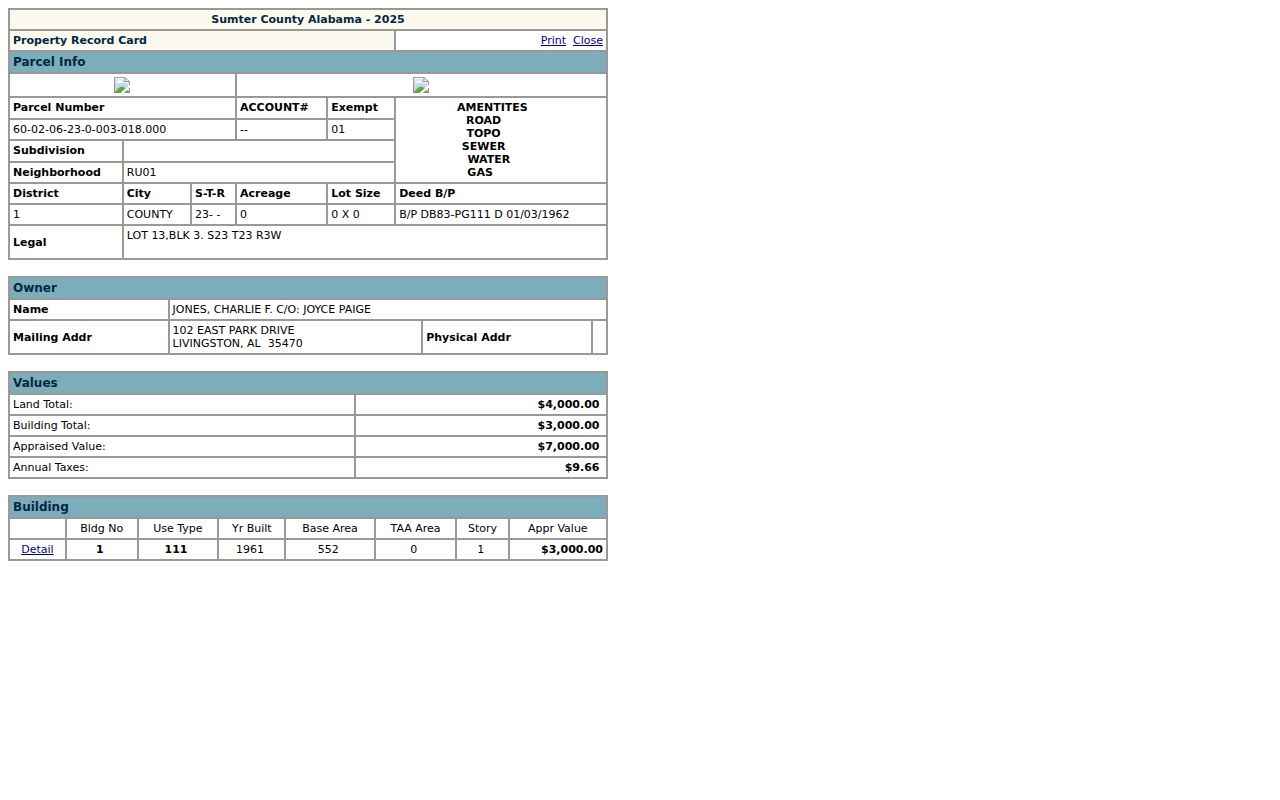
The labels are easy to spot there. Still, the card remains an assessment record, not a certified deed or title opinion.
Trace Sumter County C/O and ET AL Names
Ownership can grow murky when the Name field includes C/O, ET AL, or several names. C/O may be a mailing instruction rather than a transfer. ET AL signals other parties but never identifies their shares. A combined name string may also drop punctuation. Or it may drop capacity that appears in the deed itself.
Copy the text exactly. Then pull the Deed B/P reference. On the instrument, inspect the grantee clause, vesting language, signatures, and the full legal description. The reference may predate a later estate, foreclosure, or family transfer. Ask Probate to search forward from that party and parcel.
Follow a Sumter County Entity Owner
A business name on the GIS card answers only one layer of who owns this property. The Alabama Secretary of State business entity search can be queried by entity name, entity number, officer, agent, or incorporator. That record helps identify the organization, while the Probate deed establishes what interest it received.
Search exact and close variants, since punctuation and abbreviations can differ. An old company deed reference does not prove the entity still exists. The Sumter Farm & Stock Company sample, paired with a 1920 deed reference, shows why entity status and land title must be checked as separate facts.
Sources That Trace a Sumter County Property Owner
Each Sumter County office answers a different piece of the ownership question. Start with the assessor's parcel data to find the owner of record, then confirm it against the recorded deed. Court and probate files matter only when a lawsuit, a death, or an estate administration shaped the transfer.
| Source | Owner Info It Gives | Access |
|---|---|---|
| Tax Assessor GIS/CAMA | Name, mailing and physical addresses, parcel, legal text, deed reference | Free Basic Search and public map |
| Judge of Probate | Exact grantee, vesting, instrument date, legal description | Online-services route; confirm access, fees, and coverage with office |
| Secretary of State | Entity identity, number, officer or agent records | State business search |
| Circuit Clerk | Orders in quiet-title, foreclosure, or other civil cases | Local counter and Just One Look, subject to access rules and fees |
For an in-person or mail request, give Probate the parcel number, exact parties, book and page, date range, and legal description. The Probate Annex sits at 115 Marshall Street in Livingston. Its published hours are Monday through Friday, 8:00 a.m. to 4:00 p.m. Phone and email requests can come first. Staff can confirm whether the desired book is online, at the counter, or in older storage.
Identify Sumter County Owners After a Death
An assessor name is not enough when an estate changed the chain. Begin with the decedent's deed. Then locate the probate case and the personal representative. Find any order, and an executor's deed or later conveyance. A death certificate or obituary can lead to the right file. Neither one transfers land by itself.
Older evidence may require more than one counter. The Sumter Health Department issues Alabama vital records under state restrictions. The Judge of Probate keeps local estate and land instruments. For pre-1908 death leads, the Alabama Archives and University of West Alabama cemetery, obituary, and newspaper holdings may help identify a person. Pull the primary probate and deed records after that.
Reach Sumter County Ownership Records Offline
A failed portal is not a dead end. Call the Tax Assessor at 205-652-2424 for parcel and roll questions. Call the Judge of Probate at 205-652-7281 for recorded instruments. At the counter, bring the APN, Name text, Deed B/P, legal description, and a narrow date range. Bring your details organized.
A written request under Alabama Code §36-12-40 can describe a non-exempt public writing precisely. It can also state the desired format. Reasonable search or copying charges may apply. For older context, the University of West Alabama's Julia Tutwiler Library holds Sumter maps, planning files, newspapers, town histories, cemetery records, and related finding aids. Those sources generate leads; Probate records confirm ownership.
Limits on Who Owns This Property in Sumter County
A public ownership card has real limits. It cannot tell you who actually lives at a property. It also cannot settle unrecorded claims and liens. New deeds sometimes reach the roll late. Sumter County publishes no fixed interval for deed-to-roll updates. So the freshest conveyance may not show yet. The GIS itself warns that its data changes. It also says primary sources should be consulted directly.
Lawful use. A Sumter County owner lookup supports property diligence, estate work, and civic research. Never use a public name or address to harass, intimidate, stalk, or harm anyone.
Sumter County offers no official address-suppression route. A person with a protected-address concern should ask the Assessor, Probate Judge, and court clerk about statutory confidentiality or redaction procedures rather than relying on any private opt-out form.
Resolve Difficult Sumter County Property Owner Cases
Some owner questions refuse to follow a clean address-to-deed path. A rural tract may carry no Physical Addr at all. The owner's mail may route to a P.O. box or another county. Search instead with the punctuated 60- parcel number, the district, acreage, section, township, range, and legal description. The Basic Search even accepts an owner query using begins-with or contains logic. Run the exact surname first. Then run a careful partial form, and keep every result tied to the target land rather than trusting a same-name match.
Parcel splits and consolidations can hide the expected result too. Compare acreage, lot and block, subdivision text, and deed references on each candidate card. The legal text may have changed. Ask the Assessor whether a parent or child parcel number exists. Ask Probate for the plat, correction, or conveyance that created the change. Roads shift and mailing labels move. Section-township-range or a recorded lot description usually gives the steadier bridge back through the property records.
Foreclosure, partition, quiet title, and other lawsuits complicate things further. The newest deed may need its court file beside it. The Sumter Circuit Clerk keeps Circuit and District court records at 115 Franklin Street in Livingston. The Clerk points users to Just One Look for much electronically imaged trial-court information, subject to access rules and fees. Record the parties, civil case number, filing date, judgment or order, and any lis pendens. Then return to Probate to learn which order or resulting instrument was recorded against the parcel.
Tax-sale records deserve the same restraint. Alabama DOR separates delinquent inventory, certificates, tax deeds, redemption, and state-held land. A transcript entry or certificate alone does not settle who owns this property with clear title. Weigh the Tax Collector's current account status against any DOR record. Also weigh the recorded tax deed, redemption documents, and the assessor roll. The question may affect a purchase, estate, or disputed interest. Get a certified instrument or a professional title examination rather than treating a discovery record as a final legal opinion.