
Compare the Sumter County Property Value Layers
Tax appraisal and deed evidence answer different questions. The public card shows several fields, though the county publishes no current Sumter sale-price figure there.
| Value type | Meaning | Record source |
|---|---|---|
| Appraised value | County appraisal of the property for the assessment system | GIS/CAMA parcel card |
| Assessed value | Value after Alabama's classification ratio is applied | Assessment record |
| Land and building totals | Administrative components behind the card's appraised total | Parcel card |
| Recorded sale evidence | Consideration or purchase-price information tied to a transfer | Deed and recordation material, when stated |
Alabama applies class ratios to fair or current-use value. Class III residential, agricultural, and forest property generally sits at 10 percent. Class II general property uses 20 percent, utilities use 30 percent, and private passenger vehicles use 15 percent. Assessed value is therefore not full sale value.
See Sumter County Land and Building Value Fields
The county's sample parcel card puts Land Total, Building Total, Appraised Value, and Annual Taxes in one record. Every layer sits on one page.
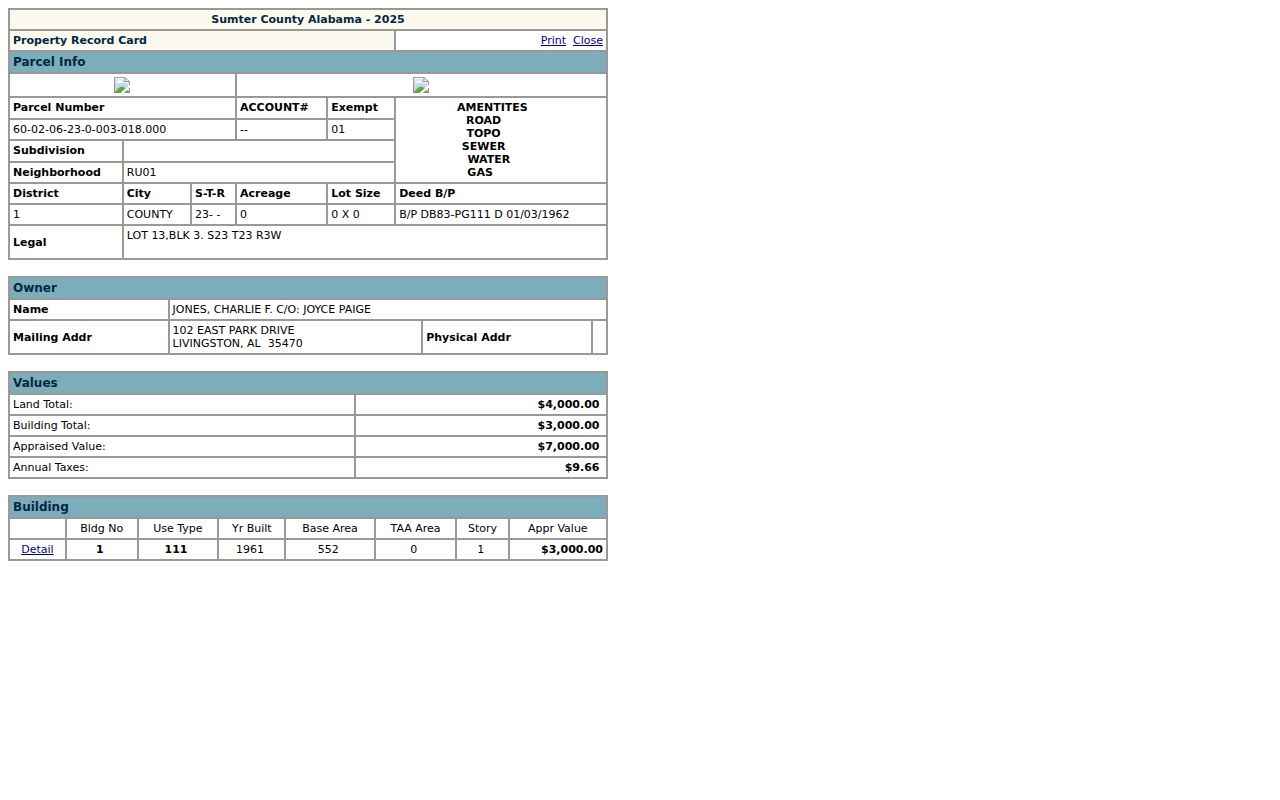
That layout helps you find each component fast. Still, the card is a tax-administration snapshot, and it does not say what the parcel would sell for today.
Estimate the Recorded Sumter County Property Value
Use the same parcel throughout the lookup. An address search can fail when Physical Addr is blank, so fall back on the parcel number, owner name, district, or legal description.
- Use Sumter GIS Basic Search with Location or the fixed 60- parcel number.
- Open the card and record Land Total, Building Total, Appraised Value, exemption code, tax year, and Annual Taxes.
- Identify the Alabama class and ratio before interpreting assessed value.
- Pull the recorded deed if a past transaction price or consideration is relevant, and note its date and terms.
- Assessed value
- The class-adjusted amount used within the tax formula.
- Appraised value
- The county's administrative appraisal shown for the parcel.
- Assessment ratio
- The percentage applied under the property's Alabama class.
- Sale or consideration price
- A transaction figure that may appear in the recorded transfer or recordation evidence.
- Reassessment
- A later review that may change the administrative value.
Understand Sumter County Land and Improvement Totals
Card samples show how types shape the mix. One small improved lot carries both land and building totals. A 240-acre parcel and a 201-acre company parcel lean heavily on land. Another card details a manufactured home.
Compare components before comparing totals. A parcel with no building value is not equivalent to an improved tract, and the card's building characteristics may come from mass-appraisal data rather than a current interior inspection.
Understand Sumter County's Annual Reappraisal Cycle
Alabama's equalization guidance calls for annual review. About a quarter of a county is physically inspected each year on a four-year cycle. That schedule matters. The source date and any property changes shape cross-year comparisons.
A new appraisal does not by itself signal a sale. Check the deed date, building record, land components, class, and any major improvement. If a figure looks wrong, save the card as viewed. Then ask the Assessor which data and valuation year produced it.
Compare Sumter County True and Capped Value
Alabama's Act 2024-344 created a 7 percent cap starting with 2025 collections. Ownership changes and significant improvements can reset or affect it. Capped growth can diverge from true value trends.
The cap is not a market forecast. Ask which uncapped and capped fields apply to the parcel and tax year. A deed event matters here. An ownership change can affect future capped assessment. But the transfer price and the capped taxable amount answer different questions.
Compare Sumter County Recorded Price Evidence
A deed or recordation-tax record may state actual consideration. That amount belongs to one transaction. Family transfers, partial interests, estate distributions, quitclaim instruments, foreclosure deeds, and multi-parcel sales rarely behave like an open-market single-parcel sale.
Deed B/P and D date fields locate the instrument. The county publishes no current public sale-price field on that interface. Ask the Judge of Probate for the recorded document. Never convert the appraised value into an assumed sale amount.
Reach Sumter County Property Value Records
Free GIS/CAMA access covers online parcel value fields. The Tax Assessor sits on Courthouse Square in Livingston, reachable at 205-652-2424, with appraisal staff at 205-652-2707. Bring the 60- APN, owner name, physical address, legal description, and tax year.
For deed consideration, call the Judge of Probate at 115 Marshall Street, 205-652-7281, open Monday through Friday from 8:00 a.m. to 4:00 p.m. The Tax Collector at 115 Franklin Street handles billed and paid status. The county offers no public indexed Sumter tax-bill portal. Alabama Code §36-12-40 offers a written-request route too. Archives help with historical values and plats.
Know What Sumter County Assessed Value Cannot Say
An assessed value belongs to Alabama's tax system. It is not an offer, a guaranteed market price, a survey, an inspection, or a title opinion. Its effective date can differ from a buyer's. So can the class ratio, cap, exemption, and mass-appraisal assumptions behind it.
Value is not price. A Sumter County assessed value does not predict what a property will sell for. Obtain a current professional appraisal when present market value must be supported.
The GIS disclaimer warns that data changes and carries no guarantee of accuracy, timeliness, or completeness. Confirm the record with the office first.
Build a Fair Sumter County Property Value Comparison
Start any comparison with matching records. Pull the same value year for every parcel. Jot down land total, building total, appraised value, acreage, neighborhood, class, exemption code, and any building traits the card lists. Keep vacant land separate from improved property. A manufactured home entry and a conventional building belong apart unless you flag the different use and improvement data. The county sample inventory makes the point plainly. One total can hide very different land and building mixes underneath it.
Location deserves the same care. Sumter GIS separates a physical Location from MailAddr. District values include COUNTY, Livingston, York, Cuba, Epes, Gainesville, Geiger, and Emelle. An owner's mailing city is not a market area. A ZIP does not establish an incorporated boundary either. Lean on parcel map position, the legal description, district, and neighborhood code as recorded. If the card's Neighborhood field is blank or overly broad, resist inventing a subdivision label just to sharpen the comparison.
Timing explains plenty of gaps too. Alabama's annual equalization process reviews part of a county each year across a four-year cycle. A sale happens on one date and an improvement on another. Track the deed date, effective assessment year, any building year or change, and the date you viewed the web record. A recent sale may reflect conditions the administrative appraisal has not yet captured. It may also carry unusual terms that make its price a poor stand-in for market value on its own.
Keep caps and exemptions in view. The 7 percent cap framework can hold taxable growth below an uncapped change, subject to ownership-change and significant-improvement rules. An exemption can lower the taxable result further. Neither means the land's market worth actually climbed at the capped rate. Ask the Assessor which card fields show appraised, assessed, capped, and exempt amounts for the year in question. Do not reverse-engineer them from Annual Taxes alone.
Handle recorded consideration with equal caution. One deed can cover multiple parcels. It can also transfer a partial interest, settle an estate, correct an earlier instrument, or move property within a family or entity structure. Read the whole instrument. Allocate no price to a single parcel unless the record itself supports it. When you need a present market opinion, a licensed appraiser can weigh current condition and comparable evidence. The public property value still works well as an administrative benchmark. Just let its label and purpose travel with the number.