
Read the Sumter County Current Owner Record
A parcel card is not a title conclusion. Match the parcel number, the address, or the legal description first, then copy the Name field and its deed reference exactly as the card prints them.
| Name | Tax-roll owner display, sometimes with several people, an entity, ET AL, or C/O |
|---|---|
| Mailing Addr | Where assessment mail goes; it may be a P.O. box or outside the county |
| Physical Addr | Situs address when carried; inspected cards sometimes leave it blank |
| Parcel and Legal | Identifiers that prevent a same-name mismatch |
| Deed B/P | Starting book/page reference for the recorded instrument |
| D date | Date paired with the deed reference on the card |
The owner of record may not live there. Mailing Addr is simply the public contact the tax record supplies. Physical Addr, when present, identifies the parcel itself, and neither field ever says who occupies the property.
Inspect Sumter County Owner-of-Record Fields
The county's sample parcel card shows owner, mailing, physical, deed, and legal fields together.
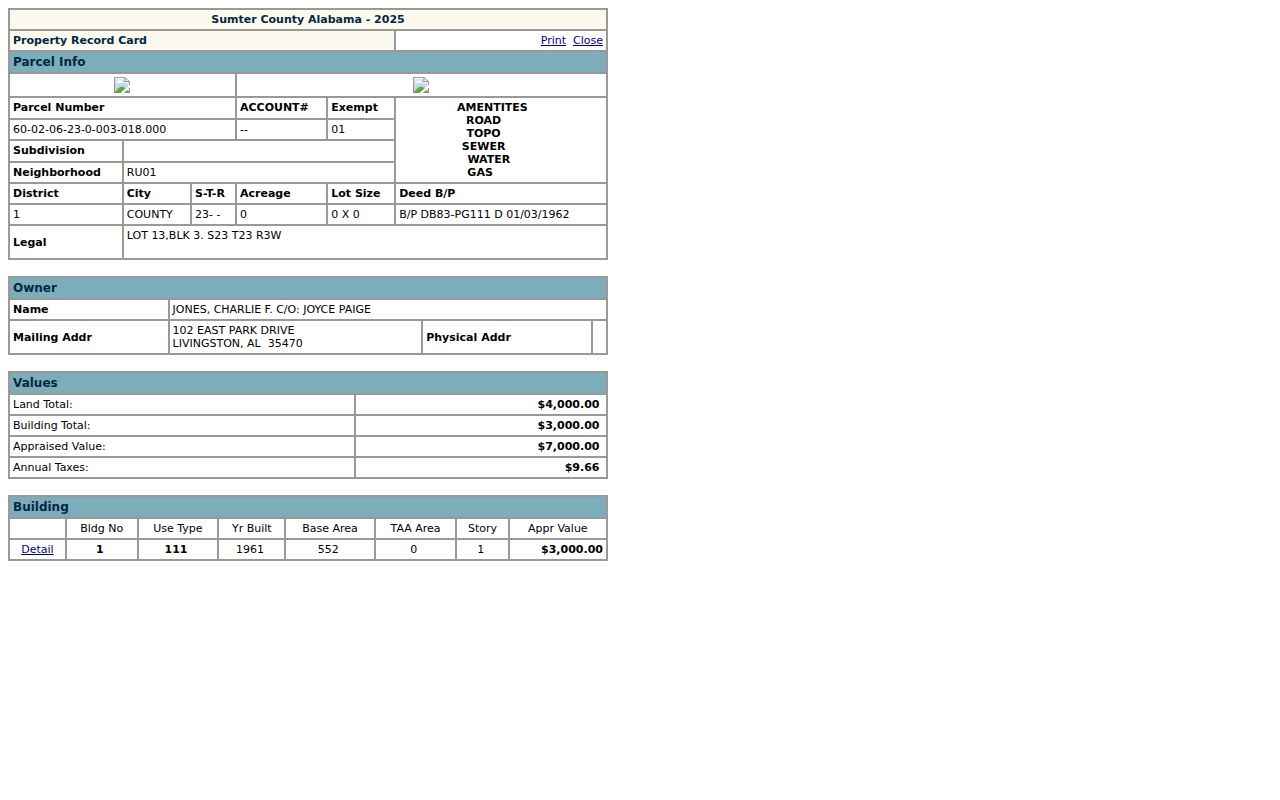
Some cards show only a C/O line. With no physical address printed, the exact wording and the deed reference deserve copying word for word.
Check Sumter County Mailing and Situs Differences
Sumter cards often split mailing and situs data in ways that surprise people. One parcel pairs a Scooba, Mississippi mailing address with a Henley Drive physical address, while others carry York, Emelle, Tuscaloosa, or Athens mail and the land still sits in Sumter County. That is not proof of an error. Mailing Addr only shows where notices go. Pin the land down with the physical address, parcel number, legal description, district, city field, and map position, and never let a ZIP or nearby place name settle the municipal boundary.
Verify the Current Owner in Sumter County
The assessment roll is where discovery begins. Sumter County publishes no set deed-to-roll update interval, so a fresh transfer calls for a deed check against the same parcel and legal description.
- Open the matching card from the Sumter GIS Basic Search and record every owner and deed field.
- Give Deed B/P, date, exact Name text, and legal description to the Judge of Probate.
- Read the newest instrument's grantee and vesting clause, then check for any later estate or court transfer.
- For an entity grantee, compare its exact name with Alabama Secretary of State records.
- Owner of record
- The party shown in the administrative or recorded record being read.
- Vesting
- The deed language stating how an interest is held.
- Registered agent
- An entity's designated service contact, not automatically the owner of its land.
Confirm a New Sumter County Deed Before the Roll Updates
A just-recorded deed can be newer than the tax card's current owner name. The county posts no update calendar. Compare the deed recording date with the card's D date, then ask the Assessor whether the transfer has entered the working roll.
Current evidence. For a recent transfer, the newest recorded instrument is stronger chain evidence than an older assessor display.
Foreclosures, estate orders, and tax deeds create the same timing gap. Never assume the person receiving the mail holds title. Reconcile the recorded instrument with the assessment entry before drawing any conclusion.
Verify a Sumter County Entity Owner
Entity ownership shows up in the card samples as a company name, co-owner lines, and C/O notations. The Alabama business entity search accepts an entity name, number, officer, agent, or incorporator as a query route. Match that file to the deed's exact grantee wording. An officer or registered agent is not an owner. C/O may just handle mail. The recorded instrument states the grantee and capacity, while the state file identifies the organization behind the name.
Reach Sumter County Current Owner Records
Start online with the free GIS/CAMA viewer to see the listed owner, then test the land-record route through the Probate office's online services. A 2023 comparison reported that Sumter County had no online land records, so confirm current access, dates, and any charges before counting on a complete free index.
The Tax Assessor sits on Courthouse Square in Livingston, 205-652-2424. The Judge of Probate is at 115 Marshall Street, 205-652-7281, open Monday through Friday, 8:00 a.m. to 4:00 p.m. Whether you call, mail, email, or visit the counter, come prepared with the parcel number, book and page, names, a date range, the legal description, and your preferred copy format. Alabama Code §36-12-40 provides the written route for non-exempt public writings. For older context, UWA and the state archives can help, though neither proves current title.
Reach a Sumter County Property Owner Lawfully
For a real property matter, use the mailing address exactly as the assessment record gives it. A returned letter does not authorize hunting for occupants or targeting relatives. Sumter County publishes no official address-suppression form. Confidentiality questions go to each records custodian directly.
Owner is not occupant. Use current owner records for lawful property diligence. Never use names, locations, or mailing details to stalk, harass, intimidate, or harm a person.
Some uses demand more than a lookup. Before legal reliance, obtain a certified instrument or a professional title search, and note that the GIS disclaimer calls its changing data general information and directs users to primary sources.
Keep a Sumter County Current Owner Audit Note
A strong owner note saves more than a name. Record the date the GIS card was viewed, the full punctuated APN, and the account number when shown. Then capture Name exactly as displayed, Physical Addr, Mailing Addr, district, City field, acreage, and legal description. Add the Deed B/P and D date. From the Probate instrument, log the recording date, grantor, grantee, deed type, and full legal description. That side-by-side record makes any mismatch visible.
Disagreement between card and deed is not always trouble. Record both facts and call the Assessor instead of editing one into the other. The gap may reflect roll timing. It could also be a name abbreviation, an estate, a correction, or a parcel split. Another parcel number may hold part of the land. A civil order may control the parcel. The Sumter Circuit Clerk at 115 Franklin Street keeps Circuit and District court records and points users to Just One Look for electronically imaged trial-court material, subject to fees and access limits.
The audit note also anchors a precise written request. It gives the custodian enough detail to separate the intended parcel from another tract held under a similar name. It also keeps the current owner question apart from a full historic chain.
Check Present Sumter County Ownership Exceptions
Give the current owner display a second look whenever the newest event was not a routine sale. Estates are a common trap. A decedent, heirs, a personal representative, or a brief estate notation may appear on different records at different times. Find the probate case and any order, executor's deed, distribution deed, or later conveyance. Then match the grantee language against the card. A death certificate or obituary can point you to the right estate. It does not vest the land.
Foreclosures and tax sales create a similar chain. A court judgment, foreclosure deed, tax-sale certificate, tax deed, redemption, and updated assessment entry are all separate documents. The Alabama DOR cautions that a tax certificate or tax deed alone does not guarantee clear title. Ask the Tax Collector for current account status. Ask Probate for the recorded instrument. Use the Circuit Clerk when a civil order controls. "Present tense" means the last effective event, not whichever record has the newest web display.
Co-ownership demands careful reading too. The sample Sumter cards include an ET AL entry and a long line listing several surnames. Neither display states each share or the form of tenancy. The deed's vesting clause may reveal separate interests, survivorship language, marital capacity, trust capacity, or an entity. Alabama conveyance rules impose recording requirements. Deeds after July 21, 1972 carry marital-status recitations addressed by Code §35-4-73. Read the instrument itself. Do not expand abbreviations from memory.
If the owner of record still cannot be reconciled, send each office a narrow question. Give the Assessor the APN, card date, owner string, and deed reference. Give Probate the parties, book/page, legal description, and date range. Ask whether a later instrument is indexed. Keep the reply, copy charge, and record date in your audit note. This respects the distinct roles of the tax roll and recorded land records. It also produces a present ownership conclusion another researcher can reproduce.