
Fields in Sumter Tax Records
Every Sumter tax card starts with a CAMA record. CAMA stands for computer-assisted mass appraisal, and it splits the data into land, building, appraised, exemption, and annual-tax fields. The assessor maintains that card. The Tax Collector handles the account-side facts, so a complete property search touches both offices.
| Field | What It Shows | Where |
|---|---|---|
| Land Total | Appraised land component | Assessor GIS/CAMA |
| Building Total | Appraised improvement component | Assessor GIS/CAMA |
| Appraised Value | Full appraisal display before class ratio | Assessor GIS/CAMA |
| Exempt | Code showing an exemption entry | Assessor GIS/CAMA |
| Annual Taxes | Tax amount displayed on the card | Assessor GIS/CAMA |
| Payment status | Live bill, receipt, balance, or delinquency | Tax Collector |
Appraised value, assessed value, and the bill are three different numbers. Alabama first applies a class ratio, then millage and exemptions shape the final tax. A deed's recorded sale price sits apart from all of it as its own evidence layer.
Two Sumter Property Tax Stops
The state Department of Revenue lists Juliet Parker as Sumter County Tax Assessor. Her free GIS and CAMA system offers searchable appraisal data. Look up any parcel number or owner of record there. For a live balance or a receipt, contact the Sumter County Tax Collector. Ask about a delinquent amount, redemption questions, or sale status there too.
Tax Collector Annie Ruth Wilson works at 115 Franklin Street, P.O. Drawer DD, Livingston, AL 35470. The office posts 205-652-2251, taxcollectorsc@yahoo.com, and weekday hours from 8:00 a.m. to 4:00 p.m. The county publishes no indexed public tax-bill portal. Phone, mail, email, and counter requests remain the essential channels.
Tax Assessor
Parcel identity, appraisal fields, district, and exemption display.
Tax Collector
Current bills, receipts, balances, delinquency, and redemption.
Search Sumter Tax Values
The Sumter GIS Basic Search takes a 60- parcel number, owner name, Location, MailAddr, acreage, total value, district, deed book and page, deed date, section, township, and range. Location is the situs address. MailAddr is the owner's separate mailing route.
| Field | Input | Tax use |
|---|---|---|
| Parcel No | 60- plus seven segments | Match the account |
| Owner's Name | Begins with or contains | Find name variants |
| TL Value | Minimum and maximum | Narrow by value |
| District | County or named place | Read tax geography |
| D Date | Date range | Check transfer timing |
The sample parcel card shows the linked fields.
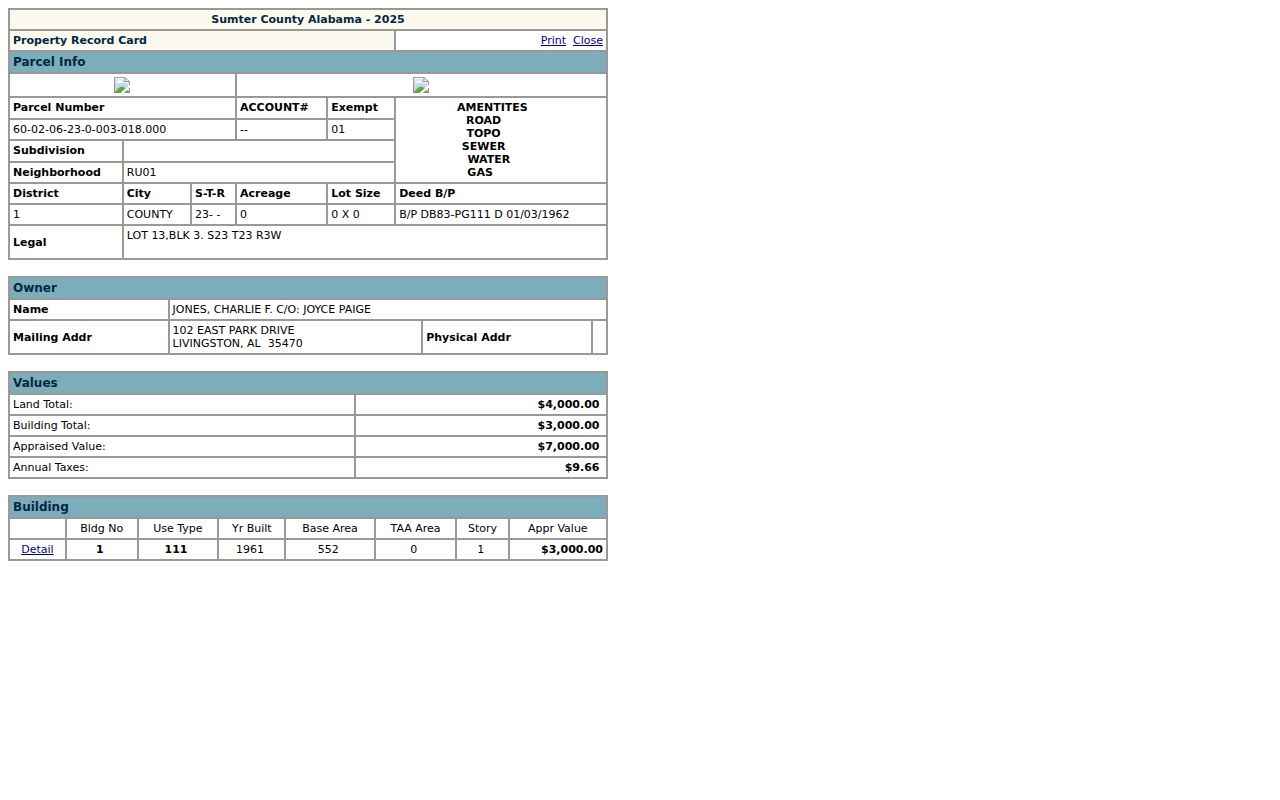
The card pulls legal, deed, land, building, appraised, exempt, and annual-tax facts into one place. Only the collector can confirm live payment status on the account.
Confirm a Sumter Tax Bill
Carry one parcel number from the assessor card straight to the collector for a full tax lookup. That single identifier avoids confusion from blank physical addresses, post-office boxes, or out-of-county mail.
- Search GIS by Location, owner, or the 60- parcel number.
- Record the district, value fields, Exempt code, and Annual Taxes display.
- Ask the collector for the current year, bill, payment date, balance, and receipt.
- If unpaid, ask whether it is delinquent, advertised, sold, redeemed, or state-held.
- Assessed value
- The basis after Alabama's class ratio is applied.
- Millage
- The rate in mills applied to taxable assessed value.
- Homestead exemption
- Relief for a qualifying primary residence under state rules.
- Tax lien
- A statutory claim tied to unpaid tax.
Alabama Classes Shape Sumter Tax
State guidance describes Class III residential, agricultural, forest, and historic property at a 10 percent ratio; Class II general property at 20 percent; utilities at 30 percent; and private passenger vehicles at 15 percent. Confirm the parcel class rather than guessing from its use.
Millage then applies to taxable assessed value. Local levies and exemptions change the result. Multiplying appraised value by one guessed rate is not a sound substitute for the Sumter property tax record.
Use-value treatment for qualifying farm or forest land also needs a direct assessor check. The label concerns tax treatment, not a public promise about sale value or development rights. Preserve the class, appraisal year, acreage, land schedule, and any exemption or use-value notation when comparing two Sumter parcels.
Sumter Reviews and the 7% Cap
Alabama's equalization program reviews roughly a quarter of each county every year. That creates a four-year physical-review cycle. The county publishes no parcel-level review calendar. Ask the assessor which cycle applies, and save the notice date.
Act 2024-344 added a 7 percent cap on covered taxable value increases. The cap starts with 2025 collections. An ownership change or a significant improvement can alter cap treatment. The cap also is not a claim that market value rose by only 7 percent.
Compare notices from the same parcel and the same year. A new building, corrected acreage, a class change, an exemption change, or a new deed may explain a shift. The taxable line may have moved differently from the appraised line. Ask the assessor to break out each part. Do not treat the card's annual-tax display as a full worksheet.
Confirm Sumter Exemption Codes
The card's Exempt field gives a code, nothing more. It does not explain eligibility, the filing year, or which levy gets reduced. Ask the assessor for the current form, the required proof, and the deadline. Ask about the code's meaning as well. Homestead and age-based relief must match state requirements.
Never assume an exemption survives a sale, an estate conveyance, or a foreclosure. Confirm the new assessment record. A recent deed can also change how the 7 percent cap applies. So keep the deed date, the assessment notice, and the application receipt together. That lets the office review the right tax year.
Separate a data question from an appeal before anything else. A misspelled name goes through a correction route. So does a wrong mailing address or a missing physical address. A dispute over appraised value follows the Board of Equalization process. One question to the assessor about which route fits can prevent a late filing. It can also prevent a misdirected one.
Note: An exemption code is a lead; the assessor must confirm its type, year, and effect.
Sumter Delinquent Tax Records
Alabama property tax comes due October 1 and turns delinquent after December 31. The Department of Revenue's tax-delinquent land page links a Sumter transcript. State-held transcripts update weekly. Some entries carry no street address, so a parcel number helps.
The DOR separates tax-sale certificates from later tax deeds. Neither gives clear title on its own. Redemption rights and encumbrances can survive the sale, so confirm live status with the collector.
A transcript is only a lead. Verify the parcel, balance, sale stage, redemption status, and title risks before relying on it.
Audit a Sumter Tax Card
Start with the parcel identity, not the money. Check the 60- APN, account number, district, city field, acreage, legal description, and deed reference before looking at any totals. Then read Land Total, Building Total, Appraised Value, the exempt amount, and Annual Taxes. One wrong digit makes everything after it worthless.
The sample cards prove the point about context. One pairs modest land and building values with a 1961 structure and a 1962 deed reference. Another spans 240 acres with a 2024 deed. A corporate owner card covers 201 acres yet still cites a 1920 deed. None of these stand for the countywide market. They simply show how acreage, improvements, ownership form, and record age vary across Sumter.
Compare like years. A current card, an older tax notice, and a deed date may reflect three different moments in the parcel's record. Annual Taxes orients you. It proves nothing about payment, delinquency, penalty, interest, or a receipt. The collector holds those account facts, so ask there. If the legal description or acreage looks wrong, ask the assessor which correction process applies before filing anything as a value appeal.
Distinguish Sumter Tax-Sale Stages
Delinquent does not mean sold. An advertised parcel, an auction result, a tax-sale certificate, a state-held entry, a redeemed parcel, and a tax deed each mark a different stage. Record the status date and the source of it. The Department of Revenue updates transcripts weekly, and street addresses may be missing. So match on the APN and legal description instead.
State guidance puts tax auctions on the first Monday in May. It also describes a general three-year redemption window carrying 12 percent annual interest. Those are statewide rules, not a Sumter calendar. Ask the Tax Collector to confirm the applicable year, the amount owed, the sale status, and redemption instructions.
A state-held purchase runs through a price-quote process with a stated payment window after the quote. Encumbrances and statutory redemption rules still apply. A certificate or tax deed never promises clear title. Search Probate for recorded instruments and the Circuit Clerk for related litigation. Get title advice before relying on any distressed-property records.
Break account questions out by tax year. Ask for the original bill, payment history, and delinquent balance. Ask about any advertising or sale date, the redemption calculation, and who added each charge. Write down every answer with the parcel number and the date you asked. Alabama guidance says unpaid property tax follows the land. A name-only search can therefore miss the account after a transfer.
The GIS card may lag behind a foreclosure or tax deed. It can also lag an ordinary sale. Reconcile the collector account, the recorded instrument, any court order, and the next assessment roll. Sumter publishes no roll-refresh schedule. Date-stamped answers from each custodian beat assuming every system updates at once.
Contest a Sumter Assessment
Alabama DOR guidance gives an owner 30 days after notice. Within that window, file a written protest with the Board of Equalization. BE-13 and BE-14 materials list facts worth gathering. These include the parcel, the stated value, the purchase price, improvements, and your grounds for disagreement. Keep the notice and proof of filing. Comparable sales, photos, repair facts, and an accurate property description can all support review. Remember that the appeal targets value and class, not title. The Sumter property value page separates the key value terms.
Watch the notice date. State guidance sets a 30-day written-protest window; confirm the exact deadline and filing method locally.