
Trace Former Sumter County Owners by Transfer
A deed-chain timeline anchors the whole effort. Sumter County has no confirmed online start year, so the layers below describe where each era of property records actually sits rather than a continuous date range.
| Transfer point | Grantor to grantee | Instrument detail | Locator |
|---|---|---|---|
| Current card reference | Read from newest deed | Deed type and recorded date | GIS Deed B/P |
| Prior acquisition | Earlier owner to later grantor | Repeat party and legal-description check | Probate index or deed book |
| Estate interruption | Decedent or estate to successor | Probate order and later conveyance | Probate case plus recorded book/page |
| Early survey context | Not an ownership transfer | Township, range, section and plat | University of Alabama collection |
Sample tax cards in Sumter County cite deeds from 1920, 1962, 2015, 2023, and 2024. Those dates prove cards can reach old instruments. Old images may not be online, though. Dates alone can mislead. Record the exact parcel number beside every dated deed reference so a later property search separates the same tract from a similarly named owner or a nearby lot.
Test Sumter County's Land-Record Route
Sumter's Probate online-services page gathers land records, probate cases, account login, search instructions, and R.E.A.A.C.T. in one place. It is a route to test. Treat it as a doorway to explore, not proof of free public deed coverage.
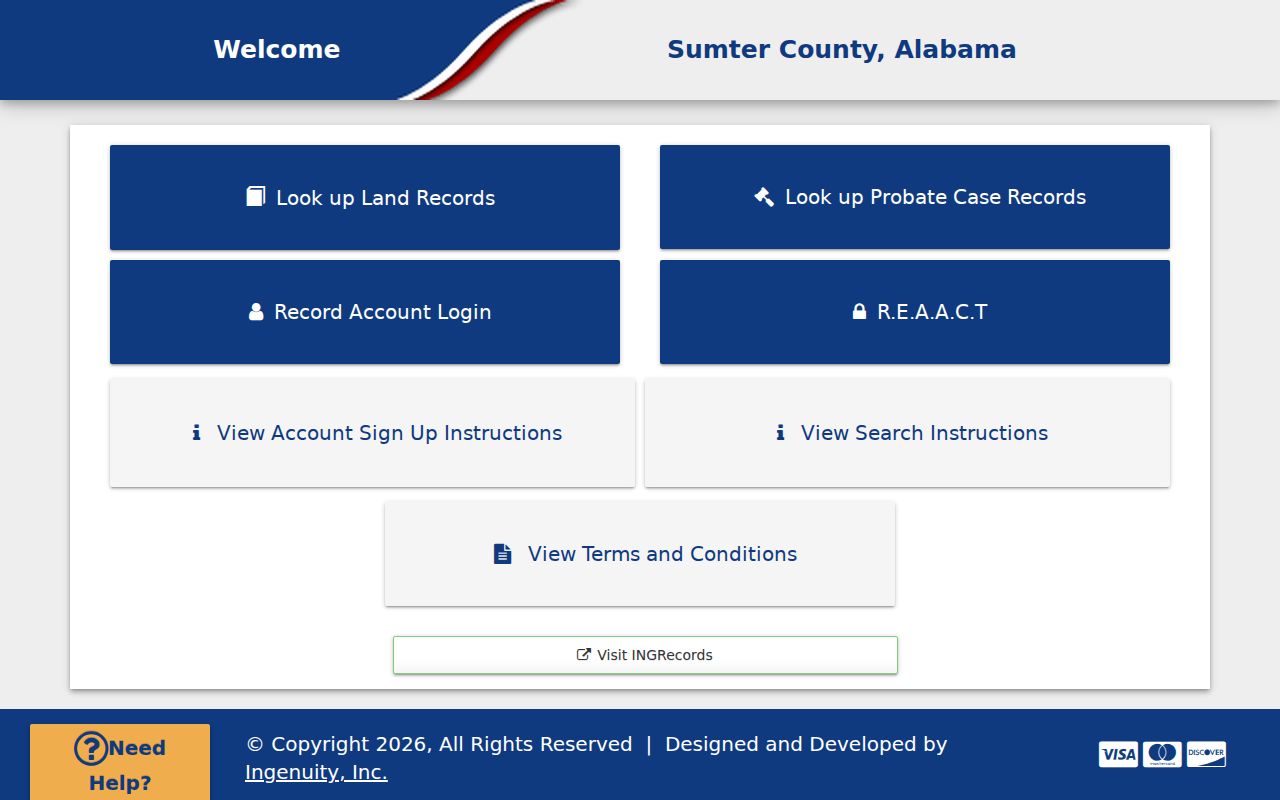
A 2023 industry comparison marked Sumter County as lacking online land records. Check that before relying on it. Confirm current access, search fields, price, and coverage with Probate so an all-online former-owner search rests on fact.
Walk the Sumter County Deed Chain Backward
Start from today's deed reference. Work backward one recorded transfer at a time. Search both sides of the index when you can, because a prior owner appears as grantor in the newer deed and as grantee in an older acquisition.
- Copy the GIS parcel's Deed B/P, D date, exact owner text, and legal description.
- Retrieve that instrument from the Judge of Probate and transcribe its grantor, grantee, deed type, and any prior reference.
- Search the grantor as an earlier grantee and confirm that the legal description still follows the same land.
- Repeat until a book is unavailable or probate, partition, foreclosure, or a changed description requires another record set.
- Grantor
- The party conveying an interest.
- Grantee
- The party receiving it.
- Chain of title
- The ordered sequence of instruments affecting ownership.
- Reverse index
- An index organized from the grantee side for backward work.
- Warranty and quitclaim deeds
- Different deed forms whose legal effect must be read from the instrument.
Reconstruct Sumter County History Through Legal Descriptions
Street addresses drift over the years. The legal description does not. A section, township, range, quarter section, lot, block, or metes-and-bounds description carries the chain. Everything else shifts. One Sumter County card reads LOT 13, BLK 3 with a section-township-range reference. Another names a northwest quarter. Compare the full text at each link. A changed acreage or new lot reference can flag a split. It can also signal a consolidation, correction, or subdivision event. Pull the recorded plat or survey reference. Do not assume the old street address still describes the same tract. Remember that the countywide 60- parcel number is a tax-map ID. It is not a deed book and page.
Go Back Through Sumter County Probate Transfers
Death can break a clean buyer-and-seller chain. Probate usually fills the gap. A death certificate or obituary is only a lead. The real proof sits in the estate case, the personal representative, the court order, and any executor's deed, distribution deed, or later conveyance recorded in Sumter County property records. A family tree proves nothing about shares. The Sumter Health Department issues Alabama certificates under state access rules. UWA holds obituary, cemetery, newspaper, and town files that may point to the right person. A former owner stands confirmed only when those leads connect to a probate order and a recorded land instrument.
Use Sumter's 1834 Plats as Survey Context
Early Sumter County deeds often describe land by section, township, and range. The University of Alabama Sumter plat index helps you picture that survey geography, since most of its holdings are 1834 township-and-range plats. A distinctive 1894 T19N R1E entry rounds out the collection.
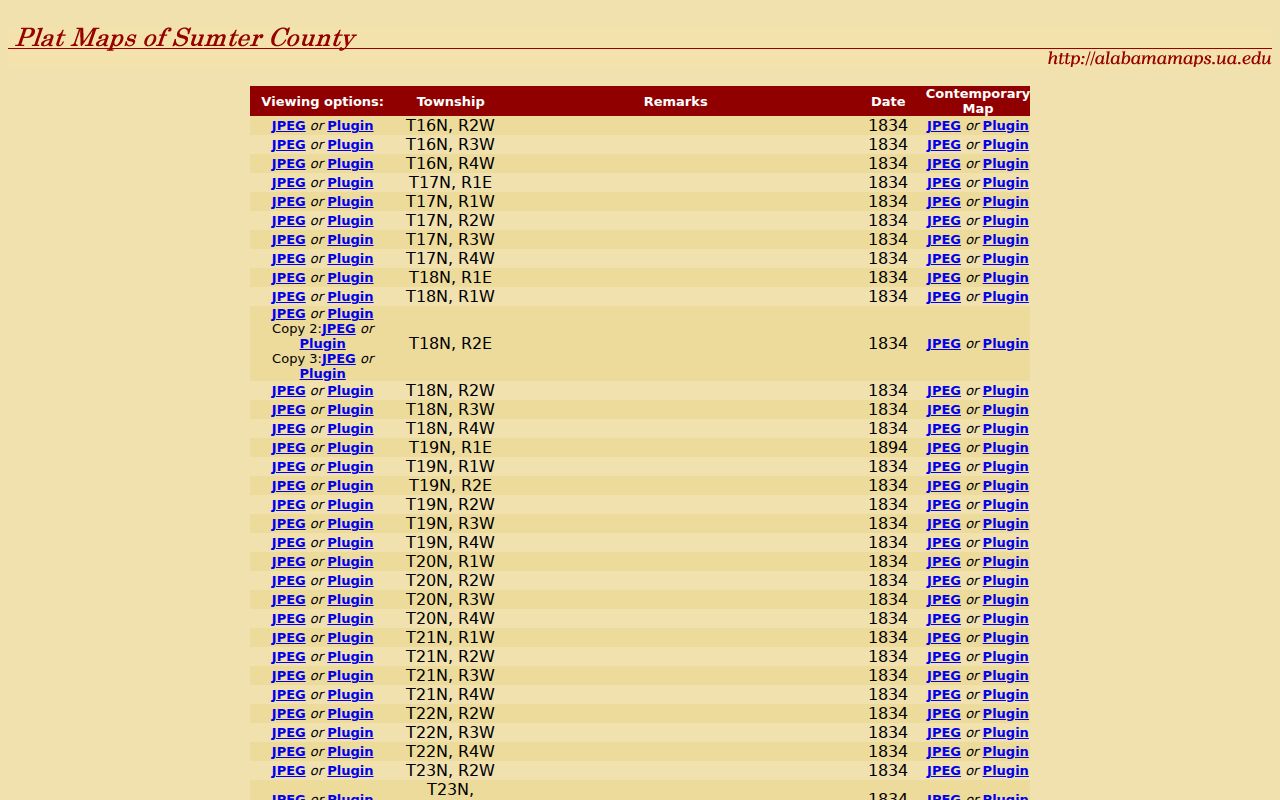
Plats do not name every former owner. They cannot replace a county deed. Treat each plat as a map into the older Sumter County property records chain, then obtain the matching deed book, land patent, or state-held land record by name and township-range-section.
Ask What Survived Sumter County's 1901 Fire
The frame courthouse in Livingston burned in 1901. The probate judge's office reportedly survived. That turns a vague records-gap worry into a precise question. Which deed books, plat books, probate volumes, or loose papers sat in the surviving office? Were some recopied later, or were they transferred elsewhere? Ask about the specific volume. The Probate Annex and Alabama Archives can answer it. UWA's courthouse and newspaper files may explain a loss or re-creation. A history source still cannot fill a missing link by itself. So state the gap openly if the primary instrument cannot be located.
Measure How Far Sumter County Ownership Records Go
No verified public online cutoff year exists for Sumter County deed records. Older owners often wait offline. The Probate counter, deed books or microfilm, Alabama Secretary of State Lands for statehood-through-1950 material, the Alabama Archives, University of Alabama maps, UWA collections, or a verified FamilySearch catalog entry may all come into play. Each holds one piece of the property records trail.
No proven web cutoff. A 1962 reference on a 2025 parcel card does not establish that online deed images reach back to 1962.
For phone, mail, email, or counter service, contact the Judge of Probate at 115 Marshall Street in Livingston, 205-652-7281, Monday through Friday, 8:00 a.m. to 4:00 p.m. Bring specifics. Supply the known book and page, parties, legal description, and date range. Ask about access, copy charges, and older storage. No local fee schedule or deed-copy form is published online.
Lawful use. Trace former owners for house history, estate work, or property diligence. Never use historical names or addresses to stalk, harass, or harm a living person.
Build a Sumter County Former-Owner Evidence Log
A solid evidence log gives each recorded event its own row. Record the instrument date, the recording date, grantor, grantee, deed type, and book/page. Add the legal description, acreage, consideration if stated, and every prior-instrument reference. Note whenever a card uses initials, ET AL, or C/O. Note a company name that differs from the deed itself. Spelling and capacity changes become visible that way.
Search both index directions around each link. The current deed names the prior owner as grantor. That person's acquisition usually shows the same party as grantee. Check nearby dates and name variants before comparing the land description. A warranty deed, quitclaim deed, executor's deed, foreclosure deed, partition order, or corrective instrument can appear. Each moves or clarifies an interest in different ways. Not every book/page event was a market sale.
A deed may cite a plat, mortgage, probate order, or earlier deed. Pull that record before going farther back. A lot may have come from a larger parent tract. The former-owner chain for the new lot depends on the subdivision or division document. Two parcels may also have been joined. Keep both old and new parcel identifiers. But remember that APNs are tax-map identifiers and may not appear in the oldest instruments.
State-held land material adds a historical layer. Alabama Secretary of State Lands covers records from statehood through 1950, with name, township-range-section, and book search paths. Later county instruments generally route to the Probate Judge. The statewide collection does not prove a specific Sumter book is online. Use it when the county chain reaches a patent or state land transaction. Cite the exact item rather than a broad collection page.
If a deed book is missing or hard to read, document the gap and turn to collateral sources. UWA's Sumter collection holds town files, maps, newspapers, church and cemetery records, genealogy material, subdivision regulations, and planning records. ADAH can help with state archival holdings. A verified FamilySearch catalog entry may identify microfilm. These aids can explain a person, place, or date. Only a primary deed, probate order, or land record should close the former-owner link. Mark every unresolved span with the last confirmed owner and the next confirmed owner. Note the missing instrument or volume sought. That is an honest chain gap, not permission to guess.